1950s–1970s
Pop Art
Mass culture as fine art. Bold, flat, ironic — the aesthetic of the printing press turned into a design system.
Principles
Bold Outlines
Thick black borders define every element. Nothing blends, nothing fades — shapes are separated by hard ink lines. This is the language of comic panels and screen printing.
Compare with Glassmorphism where edges dissolve into blur, or Nordic Minimal where borders are barely visible. Pop Art borders are unapologetic — they declare that this is a graphic, not a photograph.
Flat Primary Color
Red, blue, yellow — applied flat, without gradient or shadow. Each color fills its area completely, like ink in a printing press. No subtle transitions, no atmospheric haze.
Where Art Nouveau blends greens organically and Dark Luxury uses barely-there neutrals, Pop Art slams primaries next to each other at full saturation.
Mass-Produced Aesthetic
Pop Art celebrates reproduction. Ben-Day dots (the halftone pattern of cheap printing), hard registration lines, and flat color all reference industrial printing processes.
The style says: this was made by a machine, for millions. It is the opposite of Art Nouveau's handcraft or Victorian's artisanal ornament.
Irony and Quotation
Pop Art quotes other visual languages — comics, advertisements, packaging — and recontextualizes them. The style is never fully sincere; it always has a wink.
This makes it unique among styles on this site. Bauhaus is earnest. Swiss International is neutral. Pop Art is always performing.
Why This Style Exists
Pop Art emerged in 1950s Britain and 1960s America as a reaction against the seriousness of Abstract Expressionism. Artists like Andy Warhol, Roy Lichtenstein, Jasper Johns, and Claes Oldenburg elevated everyday commercial imagery — soup cans, comic strips, advertisements — to the status of fine art.
Lichtenstein's blown-up comic panels (with hand-painted Ben-Day dots) and Warhol's silk-screened celebrities established the visual language: flat color, hard outlines, mechanical reproduction, and the erasure of the boundary between 'high' and 'low' culture.
Where it appeared
- Fine art (Warhol, Lichtenstein, Hockney, Oldenburg)
- Graphic design and poster art (Push Pin Studios, Milton Glaser)
- Album covers (Beatles, Velvet Underground)
- Advertising and packaging design
- Contemporary web and app design (bold, flat, graphic)
- Fashion and street art (Keith Haring, KAWS)
Legacy
Pop Art's influence on design is immeasurable. The 'flat design' movement of the 2010s (iOS 7, Material Design) owes a direct debt to Pop Art's rejection of skeuomorphism in favor of bold, flat color.
Today, Pop Art lives in bold branding, comic-inspired web design, and any interface that chooses graphic clarity over photographic realism. Its lesson endures: simplicity is not the same as seriousness.
The Visual Language of Pop Art
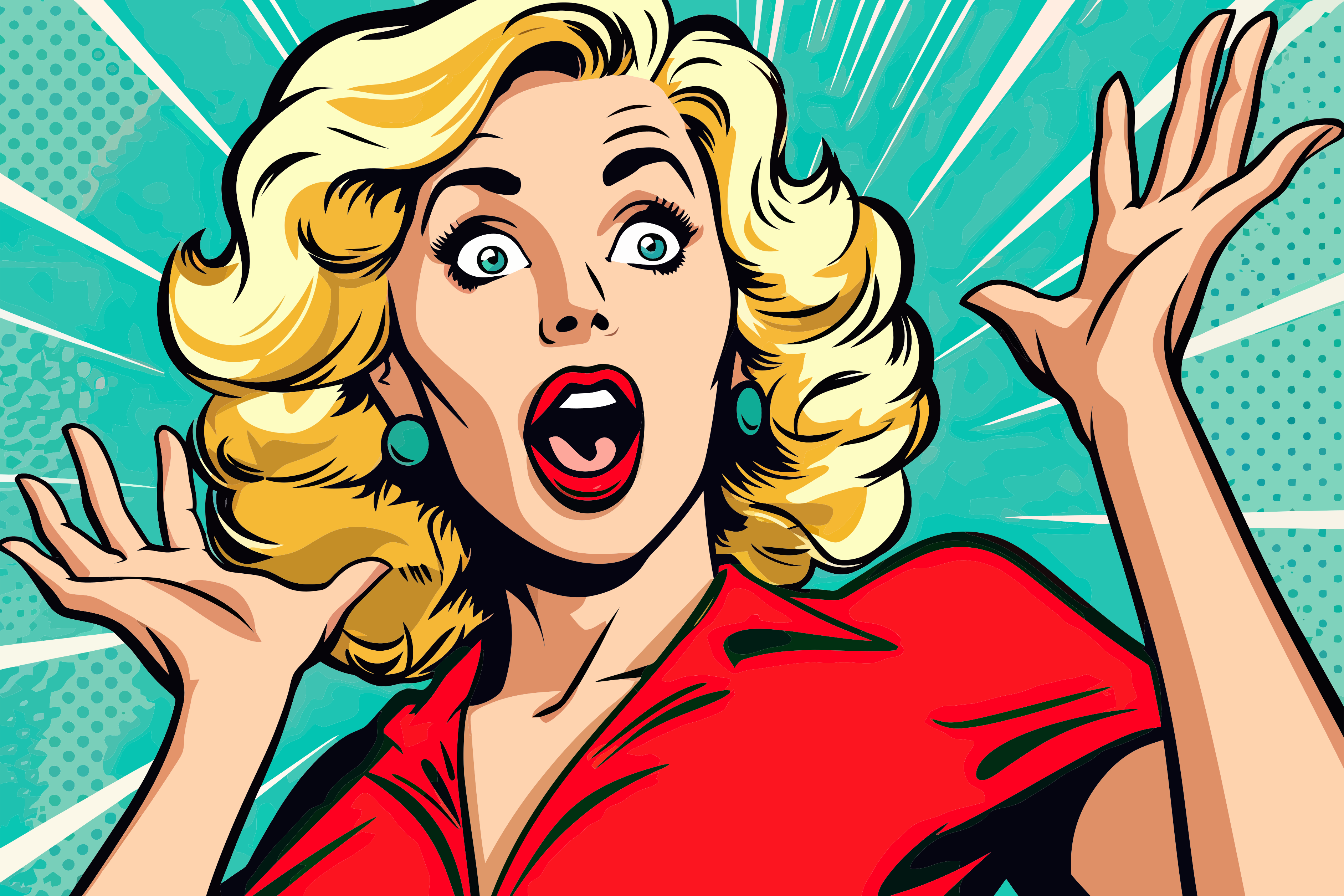
Everything Pop Art does is visible in a single image. Thick black outlines separate every form — nothing blends, nothing fades. The background uses Benday dots (halftone pattern), the mechanical reproduction technique that Lichtenstein elevated to fine art.
Colors are flat and saturated — pure red, pure turquoise — applied without gradient or shadow. The composition uses radial action lines that burst from the center, borrowed directly from comic book panels.
The expression is deliberately exaggerated and theatrical — this is not a portrait but a performance. Pop Art does not whisper. It shouts in primary colors.
Typography
Pop Art typography is loud, display-oriented, and unapologetically graphic. Headings shout — they are designed to be read from across a room, like a billboard or comic panel. Body text is friendly and informal, never academic.
- Display/comic fonts for headings — designed to be seen, not read quietly
- Informal sans-serif or comic-style for body
- Uppercase headings (shouting is the point)
- Tight leading on headings (letters packed like a poster)
Colors
Pop Art color is primary, flat, and unapologetic. No gradients. No subtle tints. Colors are applied as solid fills — the way a screen printer lays down ink. White is used generously as breathing space between bold color blocks.
- Primary colors (red, blue, yellow) as foundation
- Flat fills — no gradients, no transparency
- White background as 'paper' — the ground that holds everything
- Black for outlines and text — the ink that defines
Shapes & Ornaments
Pop Art shapes are flat, hard-edged, and outlined. Every shape has a visible border — nothing floats without definition. Corners are sharp (0px radius) because rounding implies softness, and Pop Art is graphic, not gentle.
- Thick black outlines on everything
- Sharp corners — this is print, not plastic
- Hard offset shadows (not blurred — shifted)
- Flat fills without gradient
Space
Pop Art uses space graphically — white is not 'empty', it is 'paper'. The white background is the printing surface, and colored elements are ink laid upon it. Spacing is generous (1000px width, 2-column grid) because Pop Art needs room to breathe between its loud elements. Too cramped, and the boldness becomes chaos. The hard offset shadow (4px 4px 0px black) creates spatial separation without atmospheric blur — objects sit on top of the surface, like stickers on paper.
Light & Shadow
Pop Art rejects naturalistic light entirely. There are no light sources, no ambient occlusion, no atmospheric perspective. Shadows are graphic devices — hard-edged offsets that create depth through position, not blur. The shadow is always solid black, always offset at a fixed angle (4px right, 4px down), never soft. Compare with Neomorphism where shadows simulate physical light, or Glassmorphism where blur creates depth. Pop Art shadow is a drawing of a shadow, not a simulation of one.
Contrast
Pop Art achieves maximum contrast through the simplest means: black on white for text, primary colors against white background, thick borders against flat fills. There is no subtlety — every contrast is turned to maximum. The style proves that visual impact does not require complexity.
Black Outline vs Flat Fill
The defining contrast. Every colored shape is bordered by black — figure and ground never blur together.
Primary vs White
Saturated red/blue/yellow against pure white. Maximum chromatic contrast without mixing.
Hard Shadow vs Flat Surface
The offset shadow creates spatial contrast — objects float above the page — without any gradient or blur.
Display vs Body Type
Comic-style headings vs readable body. The typeface contrast is extreme — almost two different visual languages on one page.
Rhythm
Pop Art rhythm is regular and mechanical — the rhythm of a printing press, a production line, a comic strip panel sequence. Elements repeat at even intervals. The 2-column grid creates left-right alternation. Warhol's repeated soup cans and Marilyns are rhythm made visible.
Panel Grid
Equal-sized compartments in a regular grid — comic panels, stamp sheets, contact prints. Every unit gets equal space.
Color Alternation
Warhol's method: same image, different color. Rhythm through chromatic variation within identical structure.
Border Cadence
The thick borders around every element create a steady visual beat — black line, color fill, black line, color fill.
Hierarchy
Pop Art hierarchy is blunt and graphic. Size is the primary tool — headings are dramatically larger than body text. Color is secondary — red reads before blue reads before black. There is no gentle gradient of importance; elements are either shouting or whispering.
Primary: Large red display heading
Biggest, reddest, boldest. Comic-style type at maximum size. Impossible to miss — that's the point.
Secondary: Blue accent elements
Links, buttons, highlights in primary blue. Active and clickable — the action color.
Tertiary: Black body text
Standard reading text. Clear, legible, unpretentious. Does its job without competing.
Ground: White + yellow surface
The 'paper' — white background with pale yellow cards. Holds everything without demanding attention.
Signature
Pop Art is instantly recognizable — even a single element identifies the style.
Hard offset shadow
A solid black shadow shifted 4px right and 4px down — no blur, no spread. This is a drawn shadow, not a simulated one. No other style on this site uses this technique — Art Deco uses no shadow, Neomorphism uses soft blurred shadow.
Thick black borders on everything
3px solid black outlines around cards, buttons, and containers. The comic panel border applied to UI. Compare Nordic Minimal (barely visible 1px borders) or Glassmorphism (no borders, blur defines edges).
Comic display typography
Bangers, Bungee, or similar display fonts that reference hand-lettered comic book titles. No other style uses this typographic register — it's the instant identifier.
Common Mistakes
Pop Art's graphic boldness makes it easy to tip into chaos or parody. The style needs structure underneath its loudness.
Every color at once
Using red, blue, yellow, green, orange, and purple simultaneously creates visual noise. Limit to 2-3 colors per view. White space is essential breathing room.
Outlines without hierarchy
If every element has the same 3px black border, nothing stands out. Vary border weight or use borders selectively for emphasis.
Comic fonts for body text
Display fonts like Bangers are unreadable in paragraphs. Always pair with a clean, legible body font. The contrast between display heading and readable body IS the hierarchy.
Irony without substance
Pop Art's knowing wink works only when there's genuine content underneath. A page that's all style reference and no information is empty — irony needs something to be ironic about.
Confusing Pop Art with 'colorful'
Pop Art's color is systematic — primaries, flat fills, limited palette. Random bright colors without the structural elements (outlines, flat fills, hard shadows) just look chaotic.